
“Safety by Design: How Japanese Kyudo Ranges Keep Arrows Secure.”
According to the All Japan Kyudo Federation, there are currently 1,178 kyudo ranges across Japan. On average, this means each prefecture has about 25 places where people practice kyudo, the traditional Japanese art of archery.
Japan is a country with limited flat land, and about 66% of its landscape is covered by forests and mountains. As a result, kyudo ranges are built in many different settings — from schools and city neighborhoods to rural and natural environments.
Because every location is different, kyudo ranges throughout Japan have developed a variety of thoughtful safety designs and practices to ensure that arrows remain safely within the shooting area. These solutions combine traditional knowledge, careful planning, and respect for the surrounding community.
The photographs below introduce some of the common ways Japanese kyudo ranges are designed to prevent arrows from leaving the range while maintaining both safety and the spirit of this centuries-old tradition.
The Importance of Safety in Kyudo Practice
Kyudo emphasizes precision and control, which requires a safe environment to prevent accidents. Unlike modern archery ranges that often use synthetic materials and electronic scoring, kyudo ranges maintain traditional elements that prioritize safety through natural materials and thoughtful layout. The design ensures arrows do not stray beyond the intended target area, protecting everyone present.
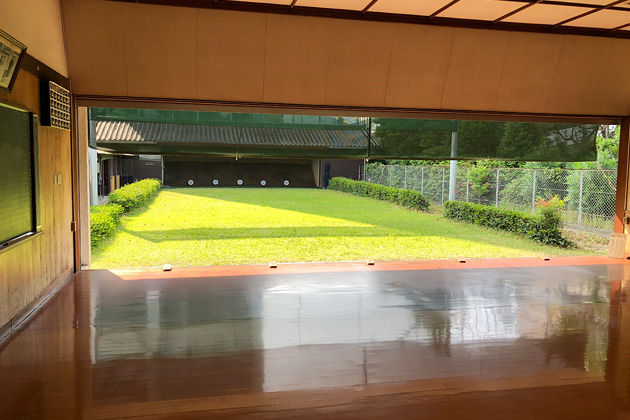


A typical kyudo range, or dōjō, is carefully planned to create a controlled environment for shooting. The main components include:
Shooting Line (Shajo): This is where archers stand to shoot. It is a raised wooden platform that clearly marks the boundary for shooters.
Target Area (Matoba): Targets are placed at a fixed distance, traditionally 28 meters for adult practitioners.
Safety Buffer Zones: Areas beyond and around the target are kept clear and often include natural or constructed barriers to catch stray arrows.
Facility Safety Design
Preventing Arrows from Passing Beyond the Azuchi
The target center is positioned 27 cm above ground level. Although arrows rarely deviate extremely upward, such incidents remain possible, particularly with beginners.
In such cases, arrows may pass up and out of the archery range. To precude this the preferred solution is:
Barrier net installed at shooting lane center

Barrier net installed at shooting lane center: Shikoku Gakuin Kyudojo
Net Placement Considerations
Nets installed closer to the dojo may be lower but create a feeling of confinement.
Wooden boards or metal sheeting may be used instead of nets; however, their weight requires strong structural supports.

Wooden boards: Saitma Koshigaya High
Proper safety infrastructure is essential despite Kyudo’s generally low injury rate.
Preventing Arrows Leaving the Front of the Shooting Lane
Beginners may miss widely to the right (when facing the target) due to arrow slip (yagobore) or weak bow-hand control.
Safety measures:
prevent arrows from exiting the front-right side
completely prevent human entry into this area
Example installation:
Protective net height: 2-3 m
Area behind net used as a student passageway

Honolulu Kyudojo
At the Honolulu Kyudojo, we plan to install metal barriers above and on the side abutting the dog park. For the mauka side a ballistic netting with secondary wood fence will provide more than adequate containment.
For anyone interested in kyudo or archery in general, understanding how range design impacts safety offers valuable insight. Whether you are a practitioner or a visitor, appreciating these details helps maintain a safe and focused environment for this ancient art.
Comments